You can get five questions wrong on the citizenship test and still pass. You cannot get one particular kind wrong. The pass rule sets a mark of at least 75 per cent overall, but it also requires every one of the five Australian values questions to be answered correctly — and those two conditions pull a study plan in different directions.
What the pass rule actually says
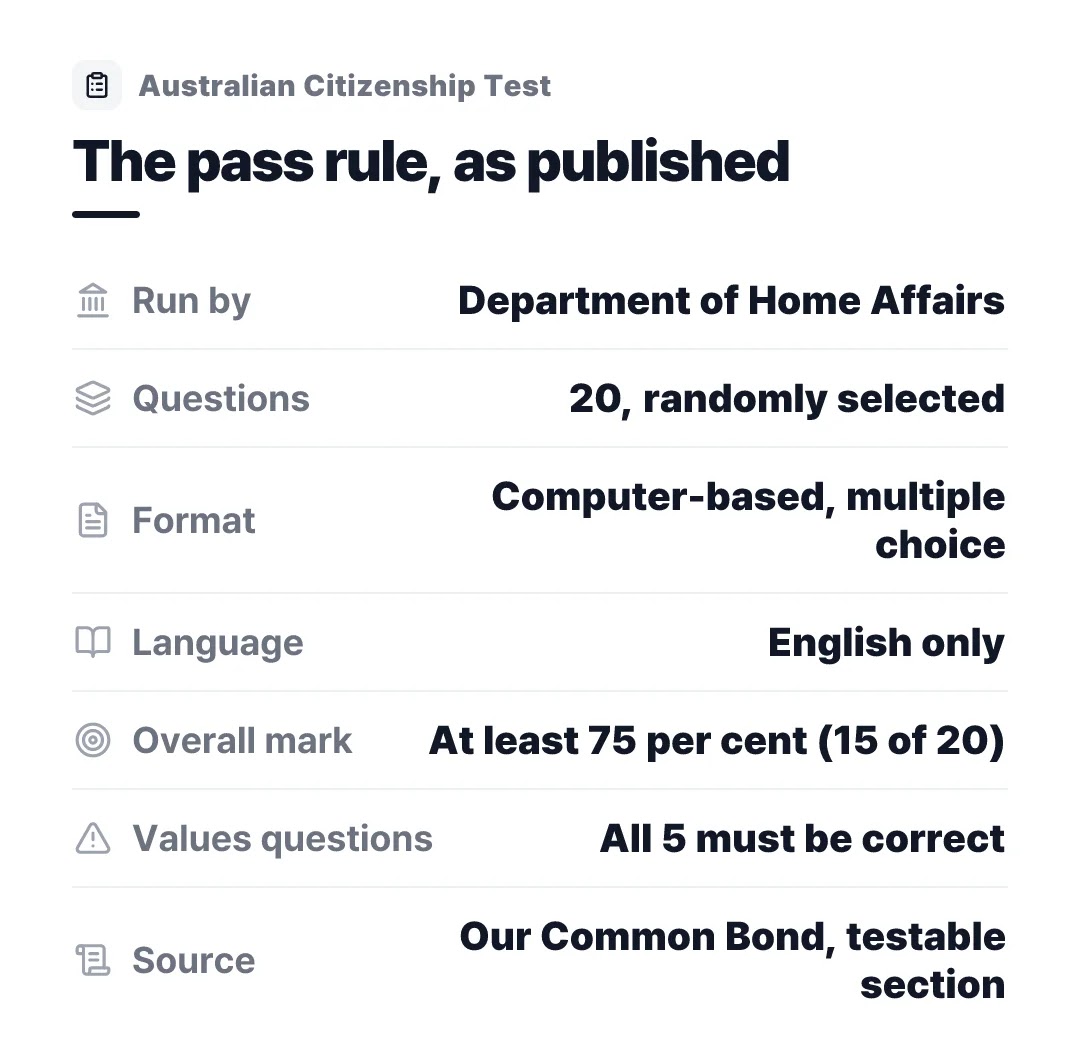
The rule comes straight from the resource booklet the test is built on. Australian Citizenship: Our Common Bond states that the test is a computer-based, multiple choice test in English, that it consists of 20 randomly selected questions, and that as of 15 November 2020 it also includes five questions on Australian values. To pass, you must answer all five of the values questions correctly, with a mark of at least 75 per cent overall.
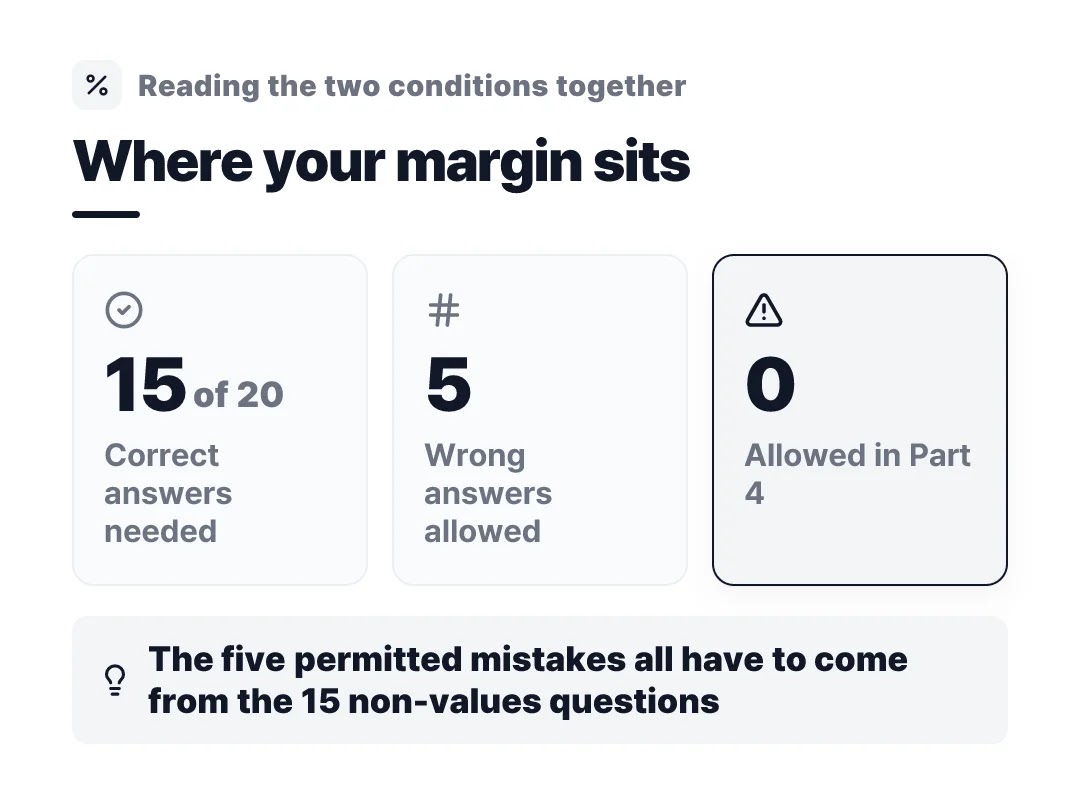
Read those two conditions together and the arithmetic falls out. Seventy-five per cent of 20 is 15 correct answers. Five of them are already accounted for, because the values questions must all be right. That leaves 15 non-values questions, of which you need 10 — so you have five wrong answers to spend, and none of them may fall in Part 4.
Where the questions come from
The Department of Home Affairs is unusually direct about the source material. Every test question is drawn from the testable section of Our Common Bond, and the Department states plainly that it does not endorse or recommend any external course, package or paid app that claims to help you pass. The booklet is free to download in English and, for the testable section, in 40 community languages — though the test itself is conducted in English only.
The testable section has four parts, and the booklet's own contents page gives their page ranges. That lets you compare how much reading each part demands against how many questions it carries.
| Testable section | Pages in the booklet | Share of testable pages | Questions | Wrong answers allowed |
|---|---|---|---|---|
| Parts 1–3 combined | 26 | 78.8% | 15 | up to 5 |
| Part 4 — Australian values | 7 | 21.2% | 5 | none |
Page ranges are taken from the contents page of the current testable edition (Parts 1–3 run pages 7–32, Part 4 runs 33–39, with the glossary starting at 40); the shares and question split are worked out from those figures and the published pass rule.
The imbalance is the point. Part 4 is the shortest stretch of reading in the booklet and the only one where a single slip ends the attempt. Parts 1 to 3 are four times the reading and carry all of your margin for error.
The four parts, and what each is for
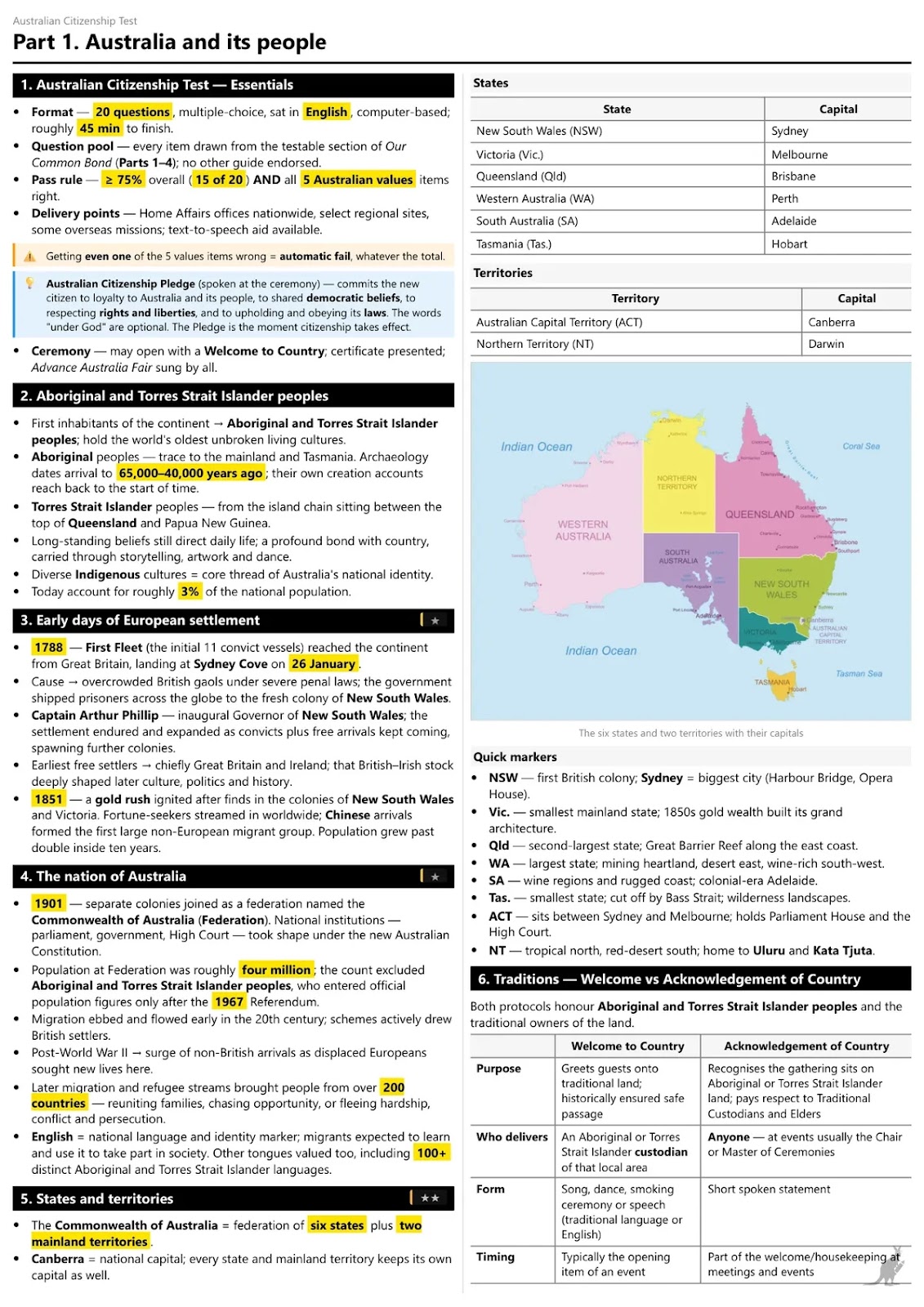
Part 1, Australia and its people, covers the continent's first inhabitants, European settlement, Federation in 1901, and the states and territories with their capitals. It is the most fact-dense reading in the booklet — dates, names, places.
Part 2, Australia's democratic beliefs, rights and liberties, moves to principles: parliamentary democracy, the rule of law, freedom of speech, association and religion, equality, and the responsibilities and privileges that come with citizenship. Part 3, Government and the law in Australia, is the structural material — the three levels of government, how a bill becomes law, the courts, the police.
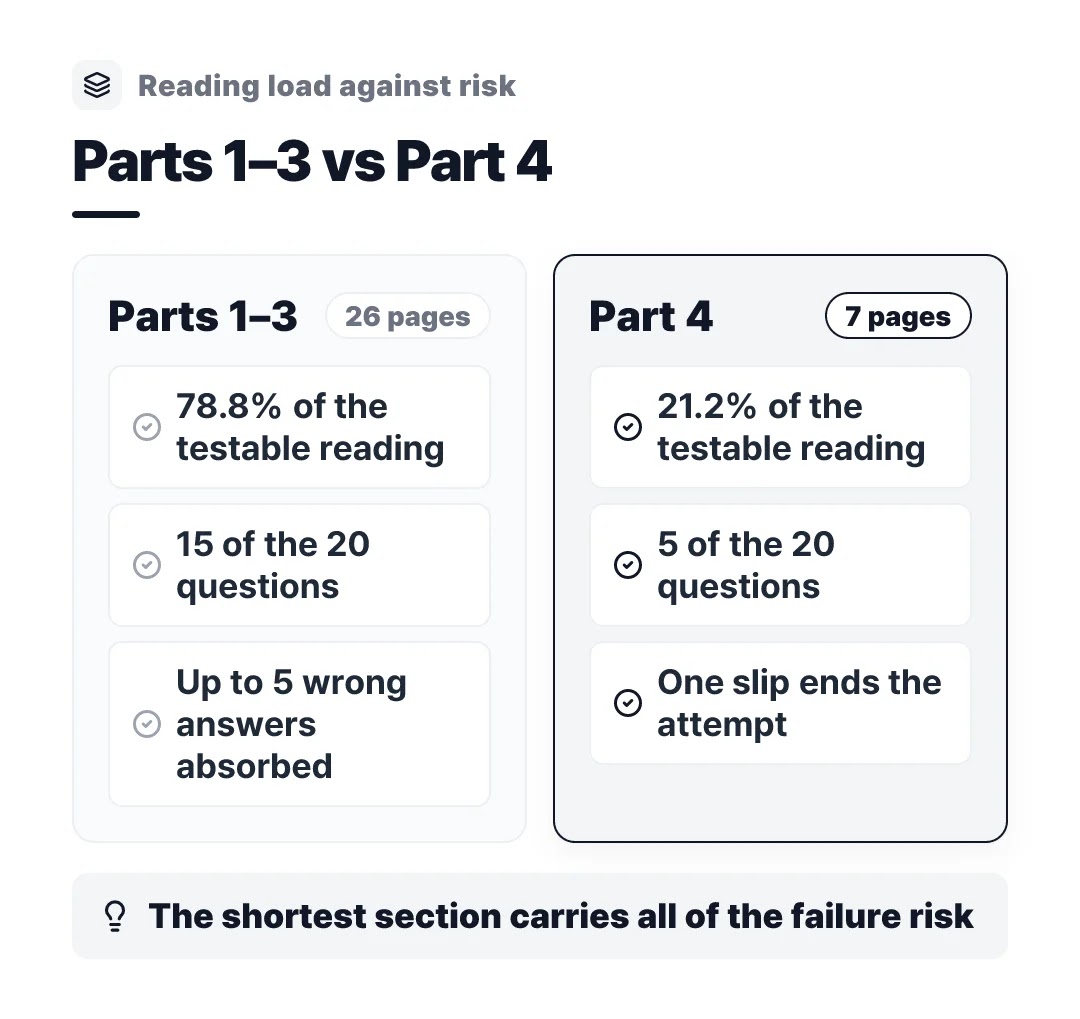
Part 4, Australian values, is short and reads as though it were straightforward. That is the trap. Because it is brief and phrased in plain language, candidates skim it, and skimming is exactly what the all-correct rule punishes.

How to weight the reading
Start with Part 4 and finish it properly before anything else. Seven pages is a single sitting, and it removes the one failure mode that no amount of performance elsewhere can offset. Read it again a day later rather than once at length.
For Parts 1 to 3, the useful move is to separate what is memorised from what is understood. Part 1 rewards a list — 1788 and the First Fleet, 1901 and Federation, the six states and two mainland territories with their capitals, the 1967 Referendum. Those are recall items and they either come back or they do not.
Parts 2 and 3 behave differently. Questions there tend to turn on distinctions rather than dates: what separates a Welcome to Country from an Acknowledgement of Country, which tier of government handles which service, what the rule of law means in practice. Learning those as contrasts rather than as isolated definitions is what makes them stick.
One practical note on the official practice test. It is designed to look and feel like the real thing, but the Department describes it as a sample only, and says the questions will be different on the day. Use it to get used to the format, not as a question bank to memorise.
What's in the 12 pages
These notes condense the testable section into a 12-page reference, weighted toward the areas that carry questions rather than covering the booklet evenly. They are a revision aid for material you have already read once — they do not replace Our Common Bond, which remains the only source the Department points to, and they contain no practice questions.
The public preview shows the shape. Part 1 is laid out with the states and territories and their capitals as a table, quick markers for each one, and a Welcome to Country versus Acknowledgement of Country comparison. Part 2 sets out the democratic beliefs and the freedoms, with responsibilities and privileges side by side. Part 3 covers the three levels of government as a table of what each tier handles, plus the path a bill takes to Royal Assent. Sections carry a one-to-three star marker showing where the questions concentrate.
👉 Australian Citizenship Test summary notes — PDF (12 pages)
https://www.preproo.com/library/australian-citizenship-test-revision-notes


FAQ
How many questions can you get wrong on the citizenship test?
Up to five, but only among the 15 non-values questions. The pass rule requires at least 75 per cent overall, which is 15 of 20, and every one of the five Australian values questions must be correct. Miss a single values question and the attempt fails regardless of your total.
Do you need anything besides Our Common Bond to prepare?
No. The Department of Home Affairs states that all test questions are based on the Our Common Bond resource booklet, and that it does not endorse or recommend external courses or paid apps. Anything else, including these notes, is supplementary revision material rather than a source of questions.
When did the Australian values questions start?
They were added on 15 November 2020. Since then the test has included five values questions within the 20, and the requirement to answer all of them correctly has applied alongside the 75 per cent overall mark.
The short version
The pass rule has two halves and only one of them is negotiable: 15 correct out of 20, plus all five values questions right. Part 4 is a fifth of the testable reading and the whole of your risk, so it goes first. Parts 1 to 3 are where your five permitted mistakes live.
Download Our Common Bond from the Home Affairs website and read Part 4 today — it is seven pages, and it is the part you cannot afford to skim.
📄 The testable section, condensed to what gets asked
https://www.preproo.com/library/australian-citizenship-test-revision-notes
Preproo is an independent publisher. This is a study aid, not accredited training, and we are not a registered training organisation. These notes are unofficial and are not affiliated with, endorsed by or produced in association with the Department of Home Affairs — the Department does not endorse any external preparation material. Nothing here is immigration advice; for eligibility, applications and test arrangements, refer to immi.homeaffairs.gov.au.